
Stitch in Time
What connects a nearly 1,000-year-old embroidery, a Scottish kilt and one of the world’s most anticipated video games? More than you might imagine. As Edinburgh’s Dovecot Studios unveils its new Bayeux Tapestry exhibition today, Hood meets British Museum curator Michael Lewis to discover why this extraordinary piece of visual storytelling remains as compelling as ever.
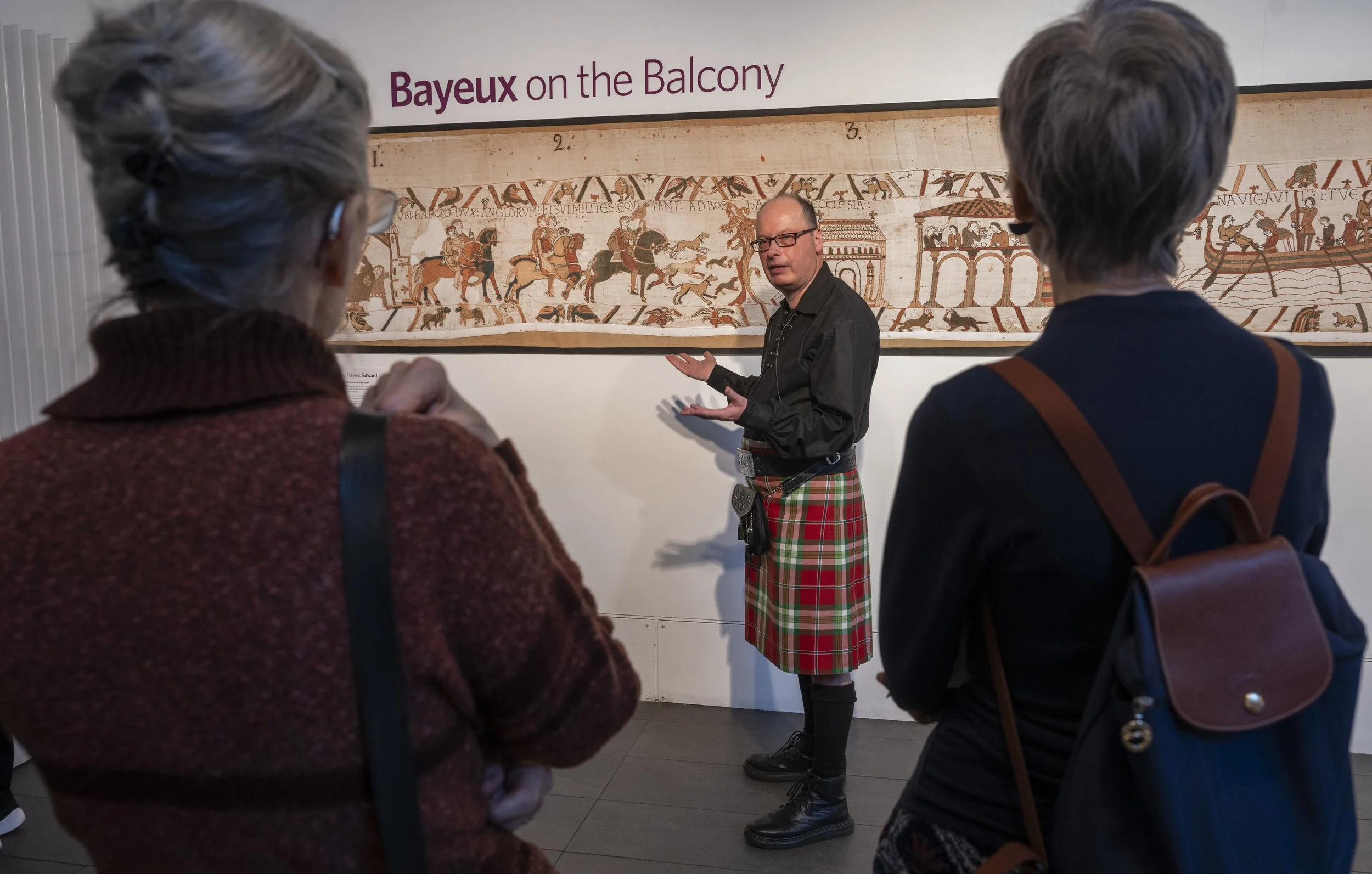
When British Museum curator Michael Lewis arrives at Edinburgh’s Dovecot Studios, he’s wearing a rather unusual tribute to one of the world’s most famous works of art. His kilt features a tartan he designed himself, using the seven principal colours of the Bayeux Tapestry. He even approached the Mayor of Bayeux for permission to name his creation the Bayeux Tapestry Tartan.
It’s fair to say his interest in this particular piece of medieval history extends well beyond the working day.
We’re meeting, exclusively, ahead of the opening of Bayeux on the Balcony, a new exhibition at Dovecot Studios that gives Scottish audiences the opportunity to appreciate the extraordinary scale of the Bayeux Tapestry without travelling to London or Normandy. A full-size, 70-metre printed reproduction stretches around the studio’s viewing balcony, where visitors can follow the story of the Norman Conquest while watching contemporary tapestry weavers at work below.
And although the original embroidery is approaching its 1,000th birthday, Michael makes a convincing case for its enduring appeal.
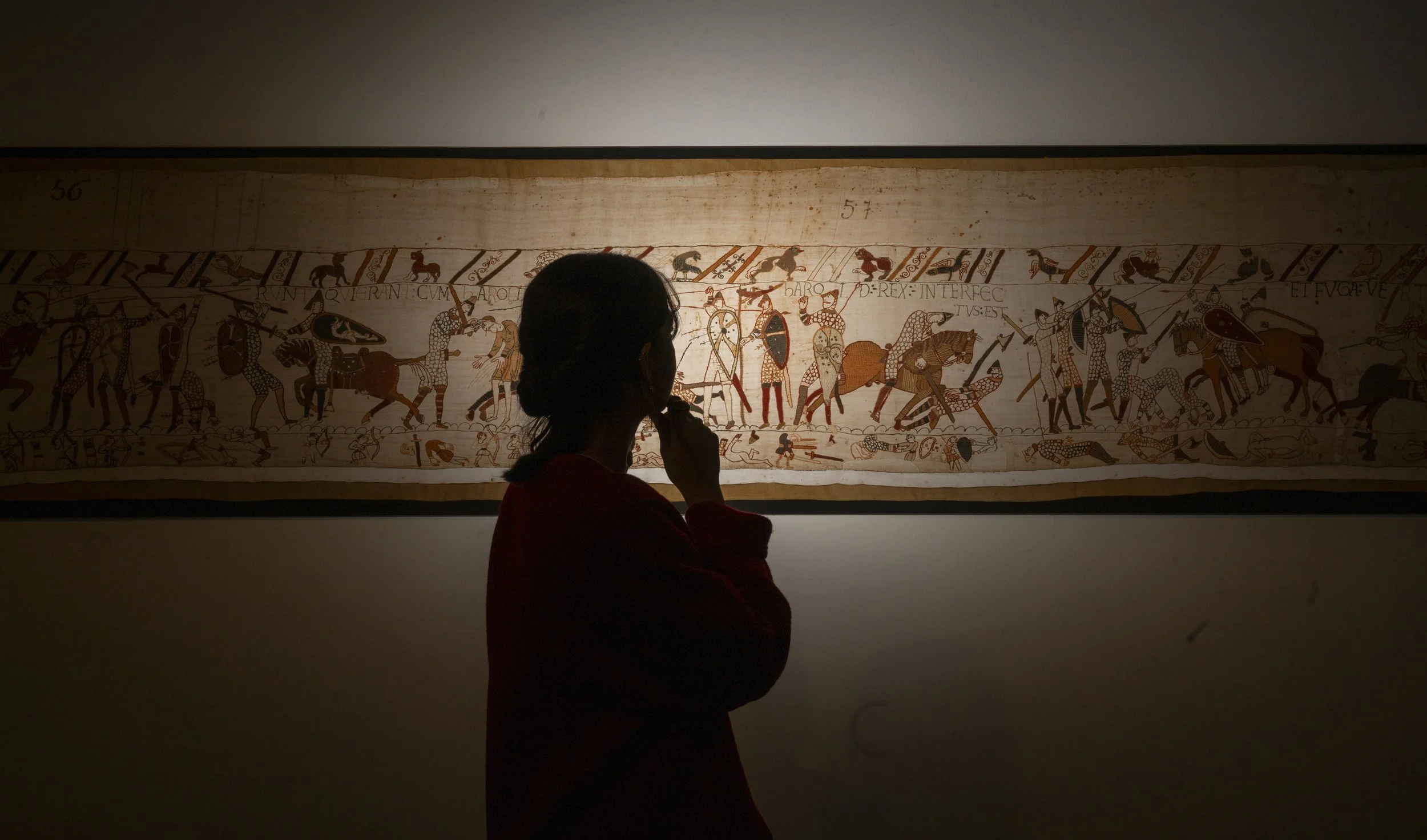
Created in the 11th century, the Bayeux Tapestry depicts the events surrounding the Norman Conquest of England in 1066, culminating in the Battle of Hastings and the defeat of King Harold II by William, Duke of Normandy. It remains one of the most remarkable surviving visual records of medieval Europe, offering an extraordinarily detailed depiction of the people, clothing, buildings, ships and weapons of the period.
For Michael, its historical significance is twofold. The Norman Conquest marked the last successful conquest of England by an invading army, making the events of 1066 a defining moment in British history. Equally extraordinary is the survival of the embroidery itself, an exceptionally well-preserved physical depiction of life in the 11th century.
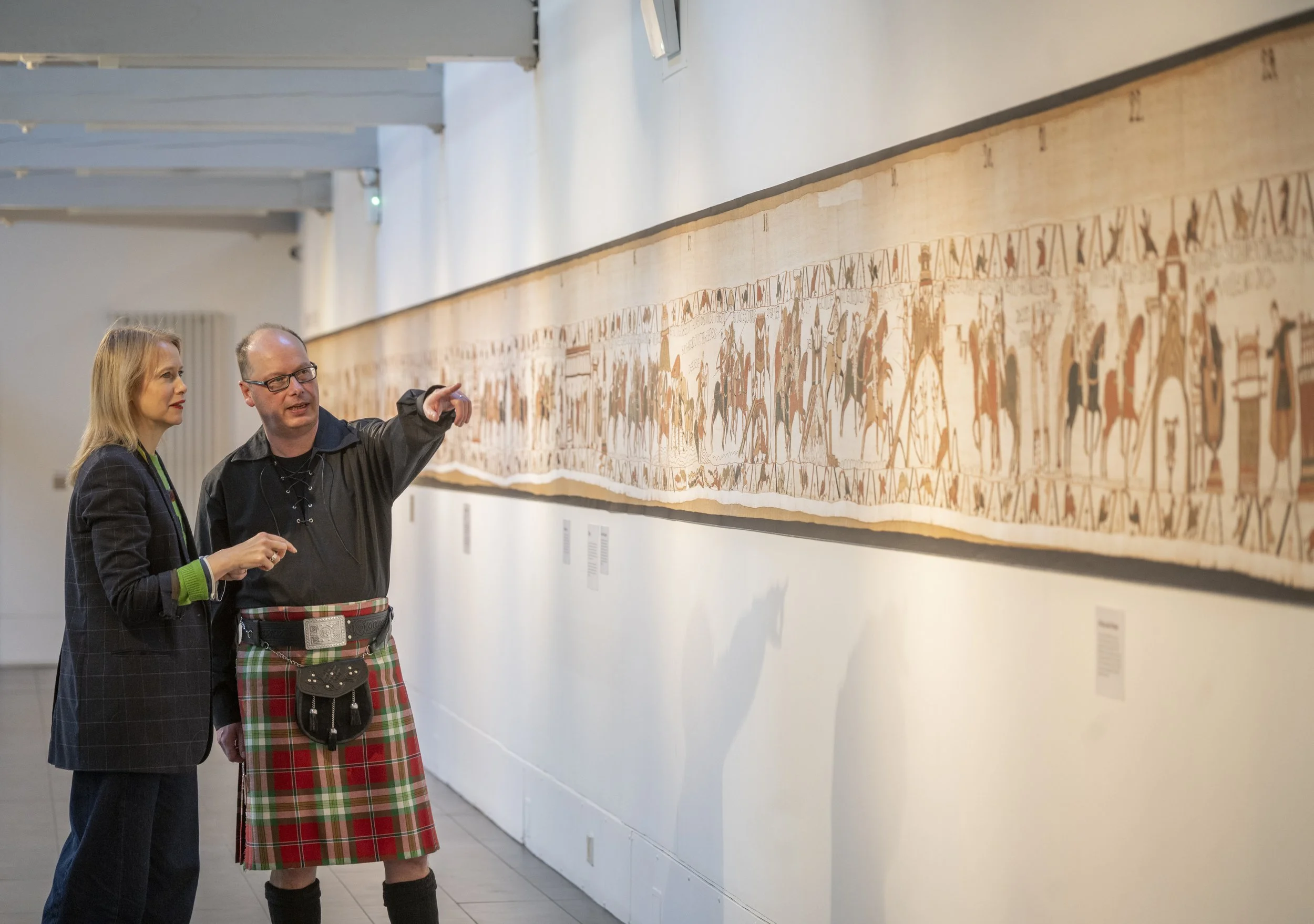
Yet you don’t need an extensive knowledge of medieval history to appreciate it. Michael likens the tapestry to a graphic novel, its appeal lying partly in the fact that visitors can follow the unfolding narrative even without knowing the full story.
There’s a rather pleasing coincidence here. Just a short walk from Dovecot, Edinburgh-based Rockstar North, the studio behind Grand Theft Auto, is celebrating the release of GTA VI in the very same week. Almost 1,000 years separate the Bayeux Tapestry and the latest blockbuster video game, yet both demonstrate our enduring fascination with visual storytelling, richly detailed worlds and, it must be said, a certain amount of violence. The technology has changed beyond recognition, but the appetite for a gripping story remains.
And the Bayeux Tapestry certainly delivers on that front. Across 58 surviving scenes, the embroidery depicts political manoeuvring, betrayal, battles and bloodshed, alongside smaller details of medieval life. Its 626 human figures, 202 horses and numerous other animals offer an extraordinary glimpse into the world of its creators.
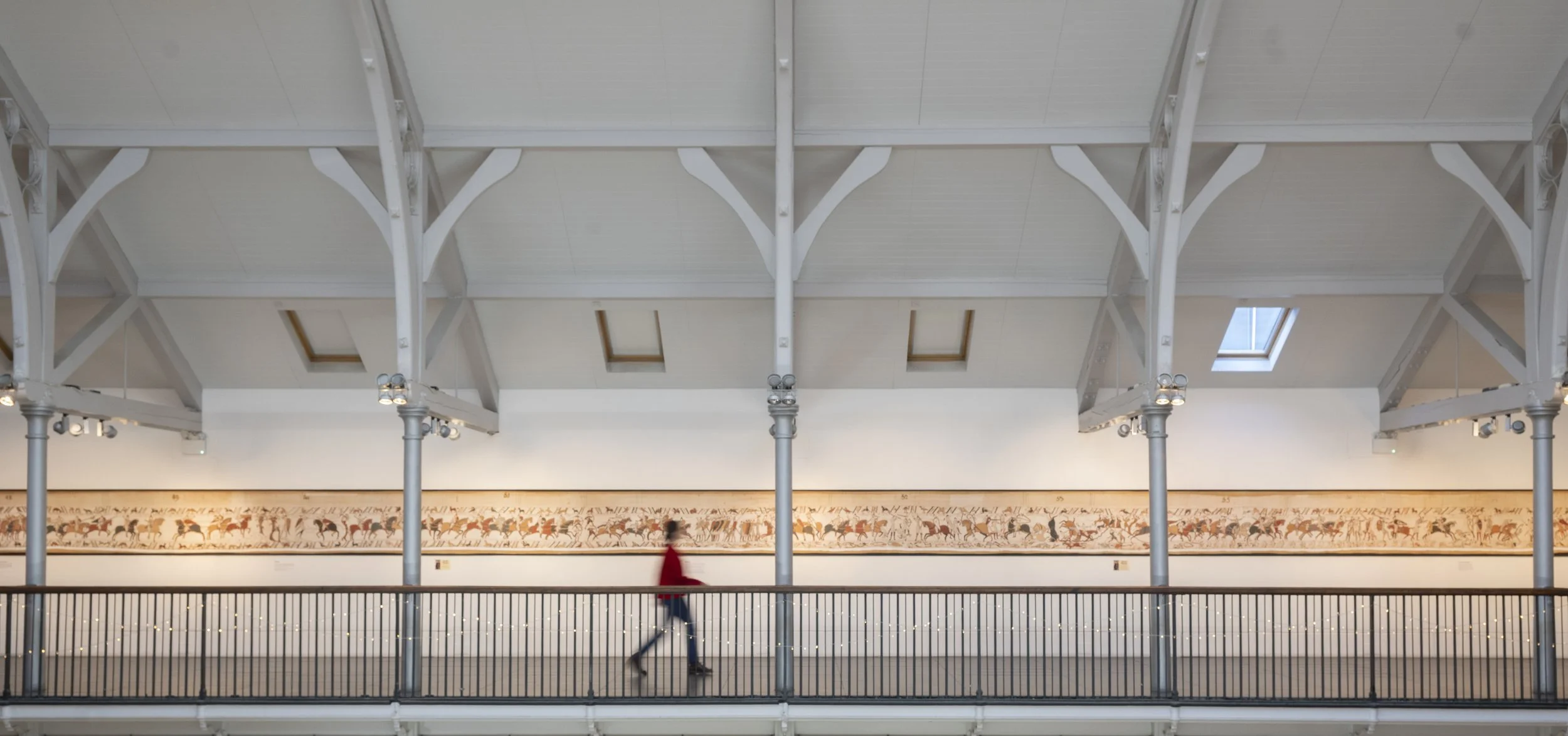
The Battle of Hastings is depicted in considerable, sometimes gruesome detail, but the tapestry offers gentler diversions too. Michael explains that while some visitors are fascinated by the violence and drama, others are drawn to the animals and birds that populate its decorative borders. It’s a work that rewards both a sweeping glance and close inspection.
For Hood, another particularly interesting aspect is the presence of women in a narrative overwhelmingly concerned with kings, soldiers and political power.
Michael draws attention to the small number of female figures depicted, including the mysterious Ælfgifu, whose appearance alongside a cleric has puzzled historians for generations, and a woman escaping a burning building, one of the embroidery’s most affecting illustrations of the human consequences of war.
These brief appearances remind us that behind the grand political narrative, the events of 1066 affected ordinary lives too. And while the identities of the people who actually stitched the tapestry remain uncertain, the skill involved in its creation is beyond dispute.
Despite its name, the Bayeux Tapestry isn’t technically a tapestry at all. It’s an embroidery, created using coloured wool threads stitched onto linen. The distinction might seem rather academic until you visit Dovecot, where it becomes central to one of the exhibition’s most interesting elements.
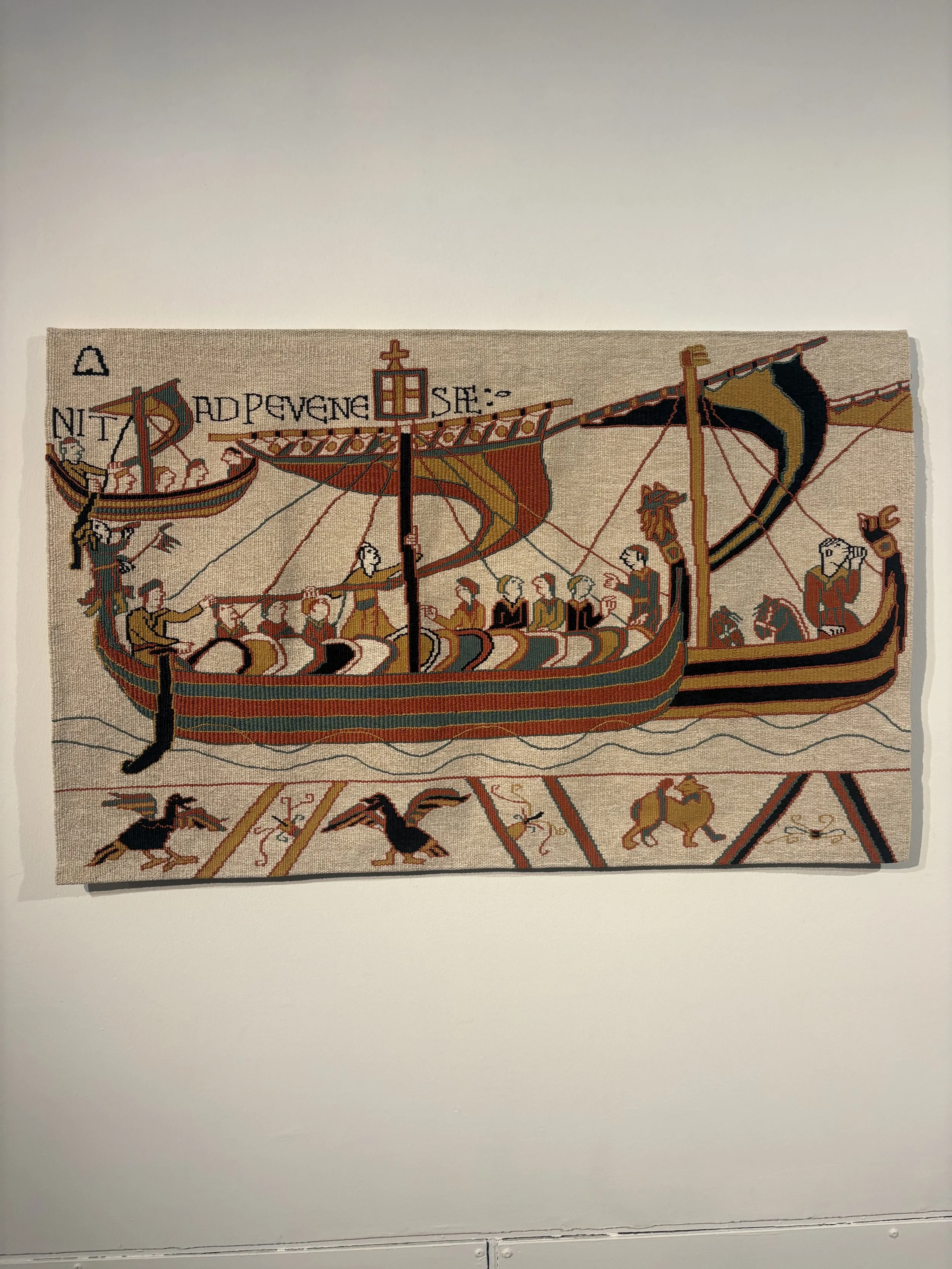
The studio’s weavers have set themselves an intriguing challenge: what would the Bayeux Tapestry look like if it had actually been woven?
Using knots and double-warp weaving techniques, they’re recreating the famous scene of William the Conqueror and his Norman fleet crossing the English Channel. Alongside them, a group of volunteers is embroidering a comparable panel, allowing visitors to see the differences between the two methods.
It’s a fascinating meeting of historical and contemporary craftsmanship, particularly in a studio that has been creating tapestries since 1912.
Dovecot’s involvement forms part of the British Museum’s Bayeux Around Britainprogramme, which brings the story of the famous embroidery to audiences across the country. The original Bayeux Tapestry is on a historic loan from France to the British Museum, while Edinburgh’s exhibition offers an opportunity to appreciate its extraordinary dimensions in a setting devoted to textile art.
For Celia Joicey, Director of Dovecot Studios, the exhibition is as much about the future of the craft as its past.
“Dovecot is delighted to celebrate this historic moment by bringing the scale and impact of the Bayeux to audiences in Scotland, while also showing what tapestry can be today. Our programme connects this remarkable historic work with the artists, weavers and makers who are continuing to push the medium forward.”
The wider programme includes talks and workshops exploring the history of embroidery and tapestry, while Dovecot’s exhibition Beyond Bayeux: Tapestry Now, at London’s Guildhall Art Gallery, brings together works created with more than 20 leading artists, including David Hockney, Yinka Shonibare and Rachel Maclean.
It’s a reminder that tapestry is far from a forgotten art form. Almost a millennium after the Bayeux embroidery was created, artists and makers continue to explore the possibilities of storytelling through textiles.
And then, of course, there’s Michael’s tartan.
It’s an unexpectedly Scottish expression of his enthusiasm for a medieval masterpiece, but perhaps that’s precisely the point. Whether embroidered onto linen, woven into a contemporary tapestry or reimagined as a tartan, the Bayeux story continues to find new forms.
Nearly 1,000 years after the Battle of Hastings, it’s still giving people something to talk about.
Bayeux on the Balcony at Dovecot is the only venue in Scotland where people can see a full-scale printed replica of the Bayeux Tapestry and runs from 21st November 2026 until 9th April 2027 at Dovecot Studios, 10 Infirmary Street, Edinburgh. Admission is free, with booking recommended.
Bayeux Around Britain national programme is supported by WorldQuant.
Find out more at Dovecot Studios
Hood exclusive interview with Michael Lewis, British Museum
Images Phil Wilkinson